What Is One Noticeable Difference Between Hellenic and Hellenistic Art and Literature?
Public Historian and co-author of "Exploring American Girlhood in 50 Historic Treasures" (Rowman & Littlefield, 2021).
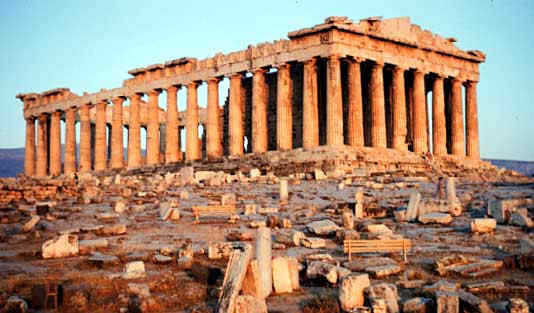
Defined
Hellenic studies focuses on the written report of the Ancient Greeks. It also studies the impact of Hellenic civilization on other time periods, such as the Medieval catamenia, the Renaissance, and modern times. This study, however, is express in scope to Ancient Greek civilisation betwixt 510 BCE and 323 BCE, a period known as "Classical Greece."
Classical Greece is primarily characterized as a catamenia where Aboriginal Greece was dominated by Athens. This was because many of the dominant scholars and writers of the period were built-in in Athens, though we do accept sources from other Greek city-states. The Hellenic Flow occurs subsequently what is known equally the Archaic Period, the determinative menses of Ancient Greece from the eighth century BCE (700's BCE) to 510 BCE. In 510 BCE, the offset democracy was created in Athens following the overthrow of the terminal Athenian tyrant, due to the efforts of Cleisthenes. The resulting democracy immune for the flourishing of gratuitous-thinkers and writers, producing some of the most well-known achievements in art, literature, science, philosophy, and other sciences.
Hellenistic studies focus on the study of the Aboriginal Greeks between 323 BCE and 146 BCE. The difference between the Hellenic period and Classical Greece lies in the date of 323 BCE: When Alexander the Groovy died.
As a result of Alexander'south campaigns, the Greek earth was forever inverse afterwards his death in 323 BCE. Alexander's campaigns had brought the Greeks into contact with a multitude of Asian cultures, and Alexander had sought to incorporate Greek and Macedonian cultures with the cultures he encountered - discouraging later practices of "conquer and assimilate." Thus, the Hellenistic period is characterized by changes in traditional Ancient Greek culture equally a result of these contacts, and so history separates the two periods.
The Hellenistic menstruum ended when the Romans came to town. Between 146 BCE and 30 BCE, the Romans conquered the Greek world slice past piece, until finally conquering the entire Mediterranean earth in xxx BCE with the conquest of Egypt. Greek culture became absorbed past the Romans, start the "Roman Greece" catamenia which lasted until 330 CE. After Roman Hellenic republic, Christianization of the European and Mediterranean worlds began, resulting in the final decline of Ancient Greece through 529 AD, when the Byzantine ruler Justinian I closed the Neoplatonic Academy (which had been founded by the Greek philosopher Plato).
For more data on the history of Aboriginal Greece, Buzzbee has created an first-class hub.
Philosophy
The Hellenic flow witnessed the invention of philosophy. There were many private philosophers during this time, each of whom had followers that often branched out from the original philosopher'southward train of thought. 1 of the most notable works of this fourth dimension is Plato's Republic, which was the earliest systematic treatment of political philosophy. Other philosophers include Aristotle and Socrates.
The Hellenistic flow witnessed philosophers who focused on reason rather than the quest for truth. These philosophers possessed a fundamental regard for reason as the key to solving problems, and they denied the possibility of attaining truth. Instead, nosotros see philosophers revert to a reliance on faith - accepting the inability to know truth. The major philosophical groups of this menstruum include the Cynics, Epicureans, Stoics, and Skeptics. Unlike the Hellenic menses, very few private philosophers existed independent of these schools of thought.
Literature
The Homeric epics originated during the Hellenic menstruation, reinforcing faith in human greatness and delighting in the beautiful aspects of life. Lyrical poetry thrived in its gentle and personal style. Tragic dramas - such equally Antigone and Oedipus - were the supreme accomplishment of the Hellenic globe, incorporated in many outdoor festivals for audiences of thousands. And one-act, notably those by Aristophanes, lacked the politeness and subtlety of other genres.
During the Hellenistic menstruum, nonetheless, that all changed. Comedies became more akin to dramas, equally evidenced in the works of Menander. Theocritus wrote pastorals that created make-believe worlds, rather than commenting on his own. And prose became dominated by historians, biographers, and authors writing of utopia.
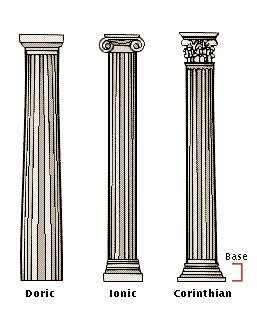
Comparing of the iii Greek columns
Fine art
Art in the Hellenic globe is what we recognize every bit Greek art today. It embodied exuberance, cheerful sensuality, and fibroid with. Marble statues and reliefs depicted human being greatness and sensuality. A notable achievement is the rise in compages of the Doric and Ionic columns.
In the Hellenistic globe, art became less "art" and more "commodity." This shift in focus led to the creation of many "trash" works. Sculpture of the catamenia emphasize extreme naturalism and unashamed extravagance, rather than the former idyllic beauties and perfect Davids. The arts of this time were supported by many wealthy patrons, who used fine art for show rather than pursue it for its own pleasure. The architecture of this menstruation also reflected the inherent materialism of art, emphasizing grandeur and luxuriance. Withal, some architectural achievements include the first lighthouse, the citadel of Alexandria, and the Corinthian column.
Science
The Hellenic world witnessed the birth of many of the world's most well-known ancient scientists and theories. In astronomy, Thales predicted a solar eclipse. In math, Pythagorean invented his theorem. Aristotle engaged in metaphysics and syllogism. Information technology was science every bit we know it today: systematic investigation coupled with rational enquiry, in the pursuit of the truths of the universe. In medicine, many scientists used philosophy rather than science. Most "doctors" considered that regularities divorced from supernatural causes created illness and health (i.eastward., God doesn't like what you did to your sister, so now you lot're sick!). Even so, this menstruum also witnessed the achievements of Hippocrates, who is considered the "father" of modern medicine and invented the exercise of bleeding patients to release the toxins.
Whorl to Continue
Read More than From Owlcation
The Hellenistic world, unlike its faults in many of the other arts, actually built upon the foundation laid by Hellenic scientists. Considered the First Slap-up Age of science, intellectual inquiry was supported by wealthy patrons who helped the sciences to thrive. The elements of geometry, physiology, and Archimedes' principle of specific gravity are but few of the many achievements of the menstruation. In medicine, achievements also connected: including describing the brain, determining pulse and its meaning, and determining that the arteries only contain blood.
Religion
Organized religion in the Hellenic world derived from the debates of philosophers. There were debates over the goals of existence, which mostly led to some kind of intellectual cultivation and the search for the highest good. The Ancient Greek pantheon of gods had been adult by this time, but the nature of the pantheon left humans able to question and debate the significance of the gods and their actions.
The Hellenistic period witnessed some major developments in religion. Zoroastrianism arose every bit 1 of the offset documented monotheistic religions, with Ahura-Mazda every bit the single god and the intercession of magi (priests) on world. Mystery cults also permeated the period, stressing ecstatic mystical marriage and otherworldly salvation. Mithraism, some other monotheistic religion, also arose in the this fourth dimension flow, with the god Mithra having been built-in on December 24 and property Sunday as a sacred day. (Does Mithra sound familiar?)
Summary
| Hellenic | Hellenistic | |
|---|---|---|
| Fourth dimension Period | 510 BCE - 323 BCE | 323 BCE - 146 BCE |
| Philosophy | Quest for truth; Individuals (Plato, Aristotle, Socrates) | Reason; Groups (Cynics, Epicureans, Stoics) |
| Literature | Homeric Epics; lyrical verse; comedy | Dramas; pastorals; history, biography; utopia |
| Art | Exuberance, sensuality; marble statues; Doric & Ionic Columns | Commodification; naturalism; extravagance; Corinthian Column |
| Science | Thales, Pythagorean, Aristotle, Hippocrates | Archimedes (geometry, physiology); the body |
| Organized religion | Derived from philosophers; questioning of gods | Zoroastrianism (monotheism), Ahura-Mazda, mystery cults, Mithraism |
Further Reading - Highly Illustrated
Further Reading - Newest Scholarship
Questions & Answers
Question: How did the political institutions of the Hellenistic world differ from those of classical Greece?
Answer: The Hellenic period is marked past a turn from the classical Greecian city-states, which were each independent of the others, and to a more centralized authorities. This is because, as a result of various wars in the 300s and 400s BCE, near of Greece came under the command of Sparta, then Thebes, and finally Macedonia. Alexander the Groovy is perhaps the best known Macedonian, and information technology was his conquests that united the Greek city-states with the rest of the earth into an empire. With empire came a huge change in politics, setting the stage for Hellenic say-so of the Mediterranean. Though Alexander was Macedonian, he was taught by and highly influenced past Classical Greek culture, so through Alexander, the rest of the Mediterranean earth became Hellenic in various ways. This would final for the rest of the Hellenistic menses, until Rome conquered all.
Question: How did Greek sculpture and drama modify during the Hellenistic Era?
Answer: Like about Greek art, Hellenic sculpture inverse from idyllic, exuberant, and cheerful sensuality in marble statues and reliefs to more of a "commodity." Hellenistic sculpture was more naturalistic and improvident; with art being used to reflect wealth rather than personal gustation.
In the Hellenic period, drama was focused on tragedies, with classics like Antigone and Oedipus as its supreme achievements, and showcased in festivals to thousands. With the rise of the Hellenistic menstruation, tragedy and comedy tended to merge into "dramas" every bit evidenced by the works of Menander and Theocritus.
Ava Rehkop on November 20, 2019:
Your website is amazing! Only give me more detail almost Ancient Greece.
gjvjruikmh on April 09, 2019:
i dearest this website keep up the skilful work.
Ced Yong from Asia on October 21, 2016:
Very informative! Shamefully, I always idea the two terms were synonyms.
John Thompson on August 08, 2016:
Hello, May I please have your full name as I discover this article very useful for my essay and I would like to cite your work.
Tiffany Isselhardt (author) from USA on April ten, 2014:
Charles, this commodity is meant merely to focus on the traditional Greek boundaries ONLY, and on aspects other than the traditional "social-economical-political" discussion. A discussion of the larger world (the non-native Hellenistic earth), and the social/economic/political would be far besides detailed for a single Hub. I aim to focus but on the differences earlier and subsequently Alexander the Great, specially apropos the arts and sciences, as a means of introducing newcomers to the topic as well every bit showcasing information that you don't typically discover in textbooks.
Aisha Darwish on April 10, 2014:
At the 2d line of the paragraph "Hellenistic studies":
The difference between Hellenistic (and not Hellenic) period and the Classical Greece.....
Charles Blitz on Apr 09, 2014:
This commodity ignores the Hellenistic world exterior traditional Greek boundaries. Why is there no talk of the social-economical-political differences between the Hellenic Greeks and the non-native Hellenistic globe
Pindar's muse on February 18, 2012:
Fantabulous definition. So many believe ancient Greece to be a uniform culture but it was multifaceted and very complex. Your article is very well thought out and well written. Great to brush upward on these two very different ideas.
Anonemuss from Belmont, Massachusetts on Oct 21, 2011:
Great piece of work. Informative and well written. I look forrad to more.
Kathy from The beautiful Napa Valley, California on July 01, 2011:
Southern Muse. I feel as if I have returned to my educational days; learning more on subjects I did not necessarily concentrate on during my HS and College pedagogy. Very well written and curtailed. I had a clue but, certainly, not a neat amount of cognition regarding this subject. Amazingly easy to read and total of comparisons, details, etc. Excellent! I enjoyed this greatly. Up Awesome and Useful
Source: https://owlcation.com/humanities/Hellenistic-versus-Hellenic-Civilization-The-istic-ic-difference
0 Response to "What Is One Noticeable Difference Between Hellenic and Hellenistic Art and Literature?"
Post a Comment